
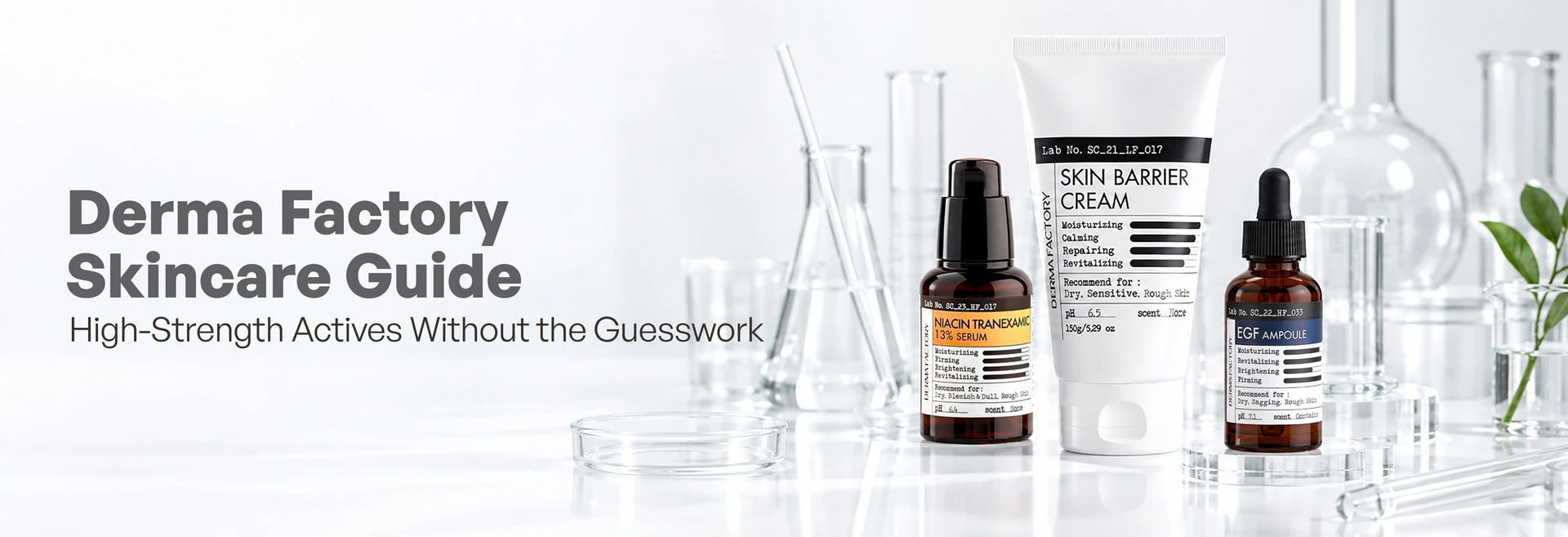
Some skincare brands invite you into a mood. Derma Factory invites you into a laboratory cupboard: neat white packaging, percentages printed in plain sight, and product names that tell you almost exactly what is inside. Niacinamide, tranexamic acid, PDRN, ceramides and panthenol are not hidden behind poetic collection names. They are the point.
That directness explains much of the Korean brand’s appeal. Derma Factory is owned by South Korean cosmetics manufacturer B&B Korea, and its formulas are produced in CGMP-certified facilities. The brand’s philosophy is equally clear: minimise unnecessary extras, use purposeful amounts of active ingredients and keep prices accessible enough that a routine does not feel like a financial commitment.
The enormous catalogue can still be intimidating. A 21% serum is not automatically better than a 13% one, and a concentrated ampoule does not excuse an irritated barrier. The smartest way to shop Derma Factory is to begin with one concern, choose one lead active, then build a calm supporting routine around it.
Why Derma Factory feels different
Derma Factory belongs to a newer school of K-beauty that puts ingredient literacy front and centre. Instead of asking shoppers to trust a vague promise of “radiance,” the brand often names the active and its percentage on the bottle. That makes comparison easier, but it also shifts more responsibility to the user.
A high number can be useful when it corresponds to a well-formulated treatment and a genuine skin need. It can also be too much when several products repeat the same active. Niacinamide, for example, appears across brightening serums, creams and sunscreens. Layering three concentrated niacinamide formulas will not necessarily brighten skin three times faster; it may simply increase the chance of stinging, dryness or flushing.
Think of the range as a menu rather than a complete set. Choose one treatment course—uneven tone, dehydration, barrier repair or early signs of ageing—and let cleanser, moisturiser and sunscreen do the quieter work.
Brightening: choose the pathway, not the biggest percentage
The Niacin Tranexamic 13% Serum is one of the most coherent places to begin. It combines 10% niacinamide with 3% tranexamic acid, then adds hyaluronic acid, a Vitamin C derivative and glutathione. Niacinamide supports the skin barrier and can help the look of oiliness and uneven tone; tranexamic acid is used in cosmetic formulas to target the appearance of persistent discolouration. Together, they create a focused treatment for post-blemish marks and patchy tone without relying on exfoliation.
Its texture is designed to deliver a high-active formula with hydration rather than grit or oiliness. Apply a thin layer after cleansing and toner, then follow with moisturiser. If you are new to concentrated brighteners, begin every other evening. Daily sunscreen matters more than adding a second brightening serum.
The Niacin Hyaluronic Acid 21% Serum takes a different route. Its headline percentage combines niacinamide with low-molecular-weight hyaluronic acid, making it a better fit for someone who wants brightening and moisture in a generous 80ml format. The rose-water base and humectant texture give it more slip than a classic clinical serum. Dry or dehydrated skin may prefer this one; reactive skin should still introduce it slowly because a high niacinamide load can feel warm or prickly.
The practical distinction is simple: choose the 13% serum when discolouration is the main concern, and the 21% serum when dullness arrives with dehydration. Do not use both in the same routine. More overlap is not more precision.
PDRN and EGF: the elasticity-focused side of the range
Derma Factory’s EGF Ampoule is a cushiony treatment built around epidermal growth factor, PDRN, collagen-derived ingredients, panthenol, niacinamide and adenosine. In skincare, these ingredients are generally used to support a smoother, more resilient-looking surface rather than to recreate medical procedures in a bottle. The ampoule is best approached as a nourishing elasticity serum: one that makes dry, tired skin feel more supple and comfortable.
Its texture suits evening use, particularly after a watery toner and before cream. Because the formula contains fragrance, very reactive complexions should patch test first. It is also unnecessary to combine it with several other “repair” ampoules at once; consistency with one formula will tell you far more than an overloaded routine.
The PDRN 1% Micro Essence Cream translates the same revitalising idea into a moisturiser. The salmon-derived PDRN is dispersed through a micro-emulsion texture and paired with niacinamide, ceramide NP, a Vitamin C derivative and adenosine. It feels more like an essence cream than a heavy balm—silky, moist and well suited to normal or dry skin that wants an elastic finish without a waxy seal.
Use the EGF Ampoule and PDRN cream together when firmness and dehydration are the priorities, but keep the rest of the evening simple. A gentle cleanse, one ampoule and one cream is enough.
Barrier care: where the brand becomes reassuringly quiet
Not every Derma Factory formula is built around a dramatic treatment percentage. The Skin Barrier Cream is the grounding product in the range, using ceramide NP, panthenol, squalane, macadamia oil and Vitamin E to support the lipid structure that helps skin hold water.
The cream’s 5% SLLS complex is designed to echo the composition of skin lipids. On the face, that translates to a dense but pliable layer that softens roughness and reduces the papery feeling that can follow over-cleansing or enthusiastic active use. Dry and sensitive skin can use it as a daily moisturiser; combination skin may prefer it only on the cheeks or as an evening finish.
This is also the product to reach for when a high-strength serum begins to feel like too much. Stop the active, return to a mild cleanser and barrier cream, and wait until skin feels entirely comfortable before reintroducing treatment. A strong routine is not one that never pauses; it is one that knows when to.
Cleansing without turning the first step into a treatment
The Jojoba 5% Cleansing Oil is a sensible first cleanse for sunscreen, foundation and long-wear makeup. Its soybean-oil base and jojoba oil provide the glide needed to dissolve oily residue without aggressive rubbing. Massage it onto dry skin with dry hands, add water until the oil turns milky, then rinse thoroughly.
Tea tree leaf oil gives the formula a fresh profile, but it may not suit everyone with fragrance-sensitive or highly reactive skin. The key is technique: thirty to sixty seconds of gentle massage is enough. Cleansing oil does not need to be worked into the face for five minutes, and visible “grits” are not proof that every pore has been emptied.
Follow with a mild water-based cleanser only when necessary. If your skin feels tight after double cleansing, the routine is too efficient at removing lipids—not insufficiently moisturised later.
Sunscreen: mineral comfort or invisible freshness
Derma Factory offers enough sunscreens to make finish—not protection claims—the deciding factor.
The Be:Zero Pure Sun Cream SPF42 PA+++ is the comfort-first option. It is a hydrating mineral sunscreen with glycerin, panthenol and guaiazulene, packaged in a generous 80g size. The texture is designed for sensitive skin and family use, but mineral filters can leave a more noticeable cast, particularly on deeper skin tones. Apply it in two thin passes and inspect the finish in daylight.
The Fresh Aqua Sun Cream SPF50+ PA++++ is the more cosmetically invisible choice. Its lightweight cream texture includes niacinamide, hyaluronic acid and a four-layer moisture complex, giving it the slip of a daily moisturising lotion. Normal, dry and combination skin will appreciate the even, non-whitening finish beneath makeup.
Whichever you choose, use a generous, even layer and reapply when prolonged exposure, sweating or towelling requires it. A sunscreen’s elegance matters because the formula you enjoy is the one you are more likely to wear properly.
Build a Derma Factory routine by concern
For uneven tone and post-blemish marks
Cleanse gently, apply the Niacin Tranexamic 13% Serum, then use Skin Barrier Cream and Fresh Aqua Sun Cream in the morning. Start the serum every other night before considering daily use. Avoid stacking it with another concentrated niacinamide treatment.
For dry, less resilient-looking skin
Use the EGF Ampoule under the PDRN 1% Micro Essence Cream at night. On mornings when skin feels comfortable, keep treatment minimal and finish with sunscreen. If the cream is not rich enough in cold or dry weather, press a thin layer of Skin Barrier Cream over the driest areas.
For sensitive or overworked skin
Temporarily skip the concentrated serums. Use a gentle cleanse, Skin Barrier Cream and the sunscreen that feels most comfortable. Once skin has been calm for at least a week, introduce one active twice weekly. A low-drama routine often produces the most polished skin.
For combination skin
Use Jojoba 5% Cleansing Oil only when removing sunscreen or makeup, select one brightening serum, and apply Skin Barrier Cream selectively. Fresh Aqua Sun Cream is the easier daytime finish; the Be:Zero mineral formula may suit days when you prefer a more protective, cream-like feel.
What to know before buying
Derma Factory’s percentage-led naming is refreshingly transparent, but percentages need context. They do not reveal the full delivery system, pH, stability or how the formula will feel on your skin. “Maximum active content” is not a command to use the product at maximum frequency.
Patch test concentrated formulas, especially those containing fragrance, essential oils, exfoliating acids or high levels of niacinamide. Introduce one product at a time and give it at least two weeks before adding another. Retinoids, strong acids and spicule products elsewhere in the range deserve an even slower schedule and should not be layered casually in the same evening.
Pregnant or breastfeeding shoppers should seek professional guidance before using retinoids. Anyone managing eczema, rosacea, active dermatitis or prescription treatment should ask a dermatologist or pharmacist before building a high-active routine.
The editor’s verdict
Derma Factory works best when you resist the temptation to turn its catalogue into a chemistry collection. The brand’s strength is choice: a targeted niacinamide-and-tranexamic serum for uneven tone, a plush EGF ampoule and PDRN cream for resilient-looking hydration, a serious barrier cream for recovery, and sunscreens that account for different preferences in finish.
Start with one headline product and surround it with calm essentials. The result is the real promise behind Derma Factory’s clinical packaging—not skincare made more complicated, but active ingredients made easier to understand.